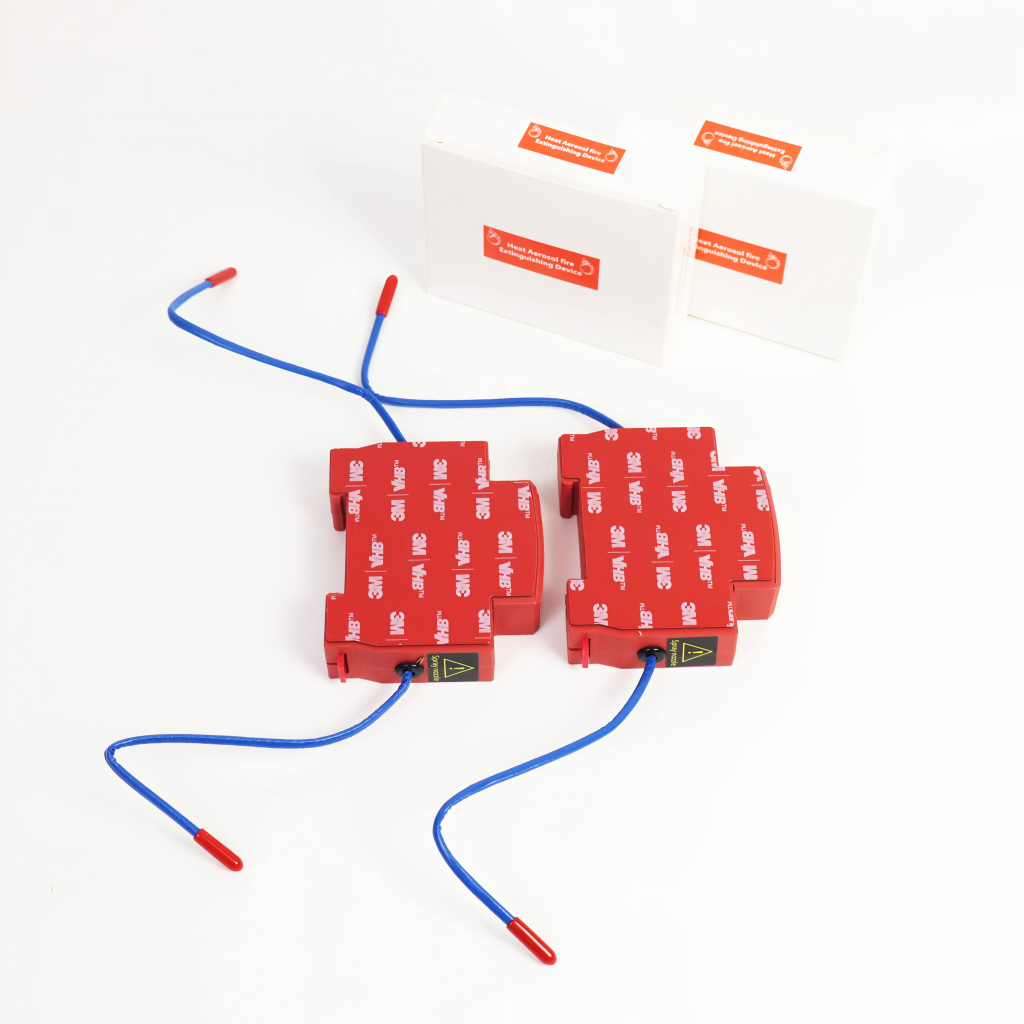
Supplier range photograph. The exact appearance and dimensions of this model require a model-specific drawing.
Product specification / QRR0.02G/S
DIN Rail Thermal Aerosol Fire Extinguisher — 20 g
A compact, single-use thermal aerosol device for electrical enclosures. No external power supply is required. Available in 10 g, 20 g and 30 g formats, with DIN-rail and adhesive mounting options. Model selection requires a review of enclosure volume, ventilation and installation conditions.
Models & technical specifications
| Model | Agent dosage | Protected volume (reference) | Details |
|---|---|---|---|
| QRR0.01G/S | 10 g | Up to 0.1 m³; application review required | View details |
| QRR0.02G/S | 20 g | Up to 0.2 m³; application review required | View details |
| QRR0.03G/S | 30 g | Up to 0.3 m³; application review required | View details |
The stated maximum protected volumes are selection references for suitable enclosure conditions. Review ventilation, openings, partitions and fire hazards. Do not add model capacities together to assume coverage of a larger enclosure.
Specifications for this model
Technical overview
Product specifications
| Agent dosage |
20 g |
|---|---|
| Protected volume (reference) |
Up to 0.2 m³; application review required |
| Activation method |
Thermal activation; no external power required |
| Activation temperature |
170°C |
| Activation response |
Aerosol generation starts within 15 seconds after reaching the activation temperature; not a guaranteed extinguishing time |
| Mounting options |
35 mm DIN rail or adhesive mounting; confirm adhesive specification |
| Housing color |
Red |
| Thermal probes |
Two probes, located at the top and bottom |
| Probe cable length |
Standard 10 cm per probe; 10–50 cm customization stated in supplier TDS |
| Operating temperature |
−50°C to +90°C |
| Humidity tolerance |
<95% RH, non-condensing |
| Aerosol generation duration |
Pending reconciliation of supplied documents |
| Service life |
Pending reconciliation of supplied documents |
Source: supplied TDS and general specifications. Conflicting duration and lifetime figures are held for confirmation. The source package does not include a model-specific clearance drawing or supporting test report.
Applications
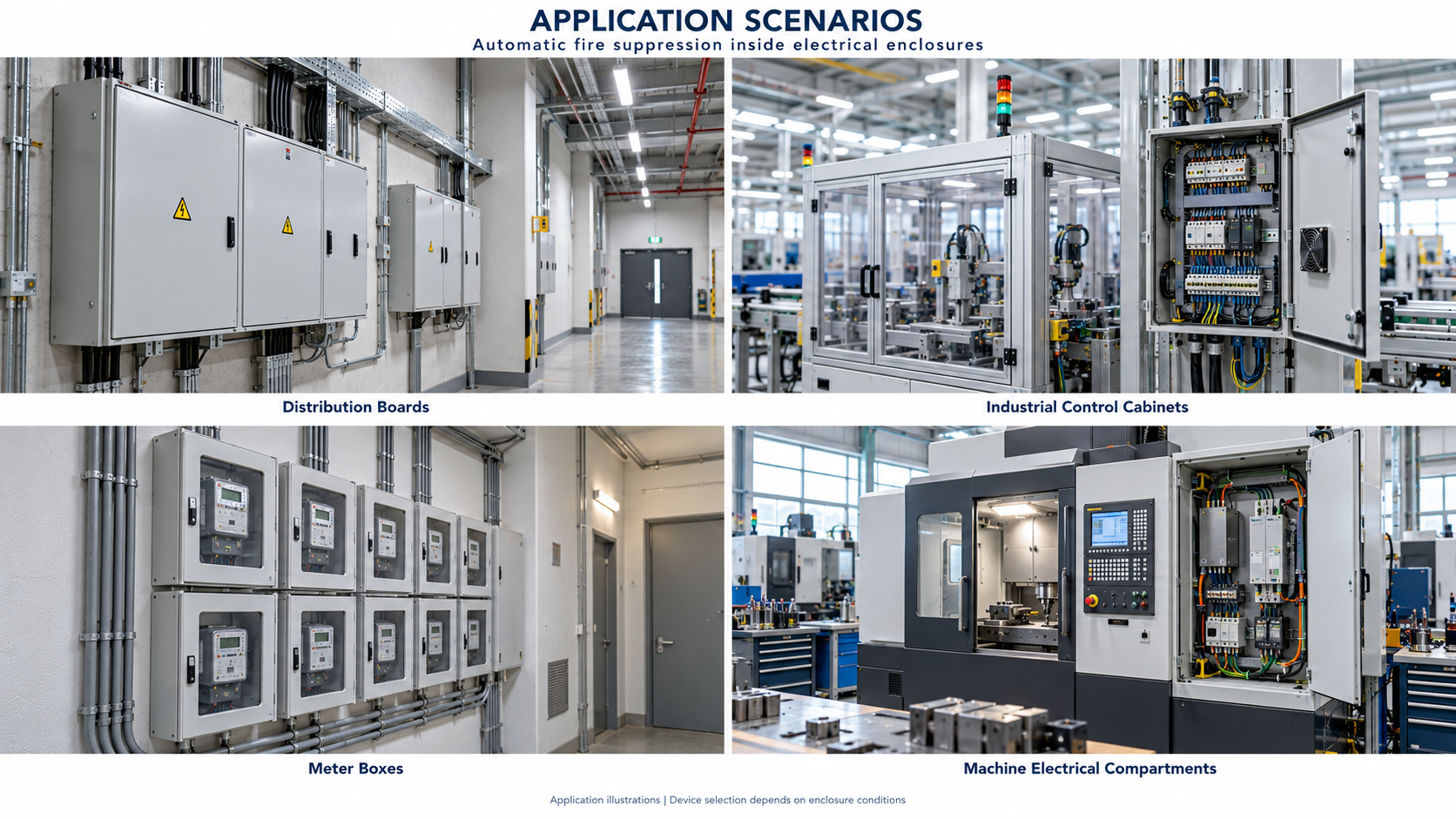
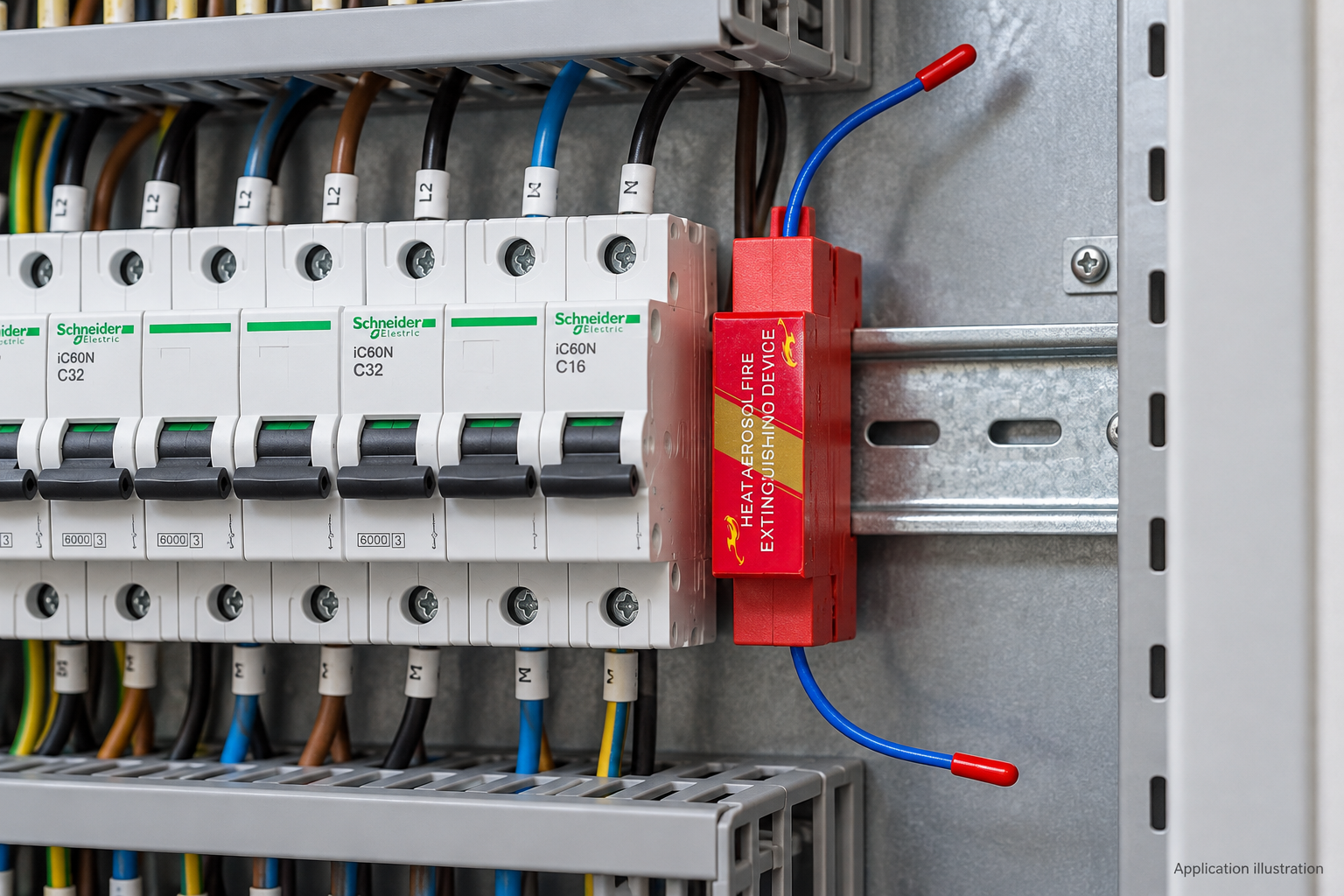
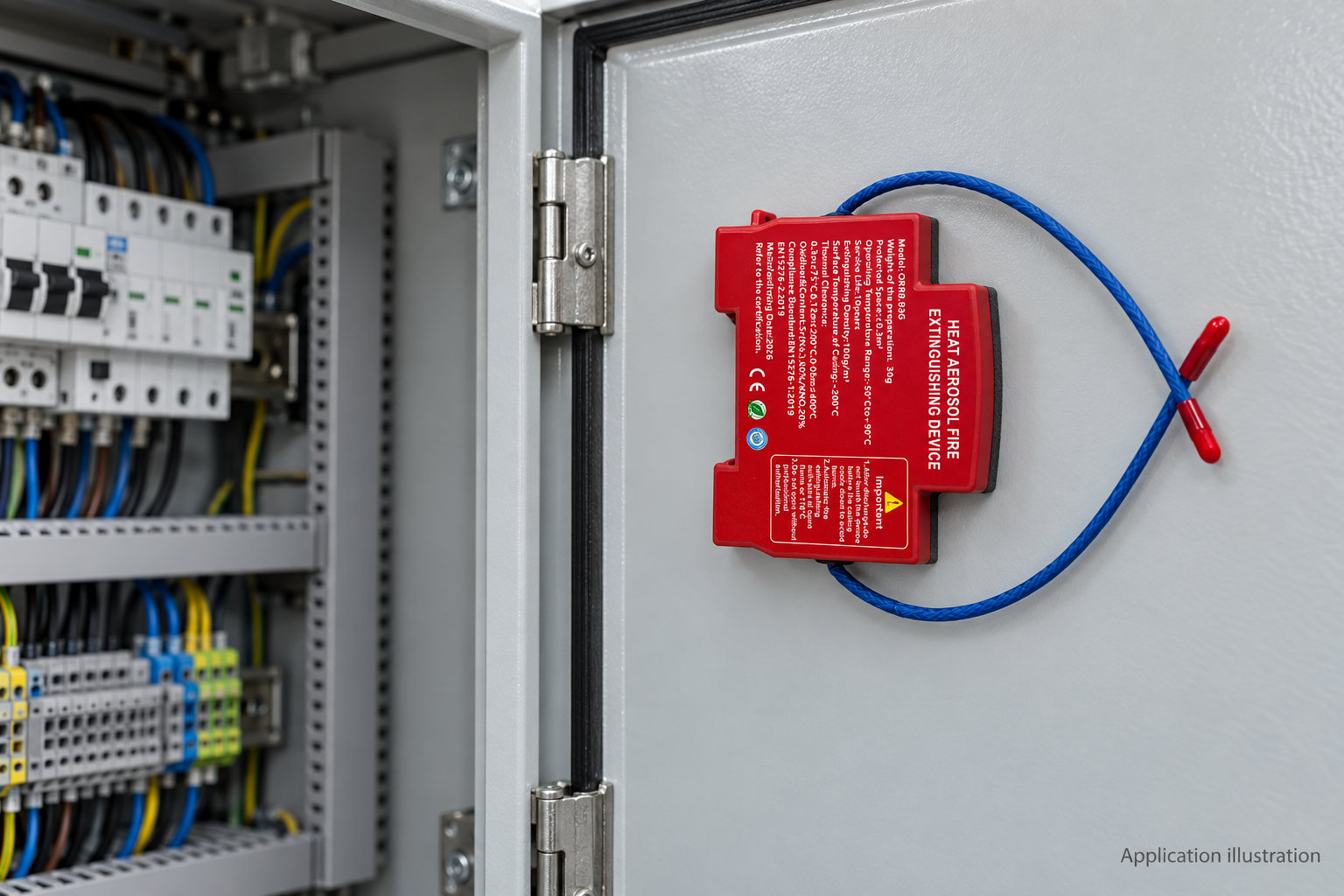
Intended applications described in the materials include distribution boards, meter boxes, industrial control cabinets and machine electrical compartments. Suitability depends on enclosure conditions and requires application review.
How it works
Automatic heat activation
- Heat detection. Thermal sensing cords respond to direct flame or the specified activation temperature of 170°C.
- Activation. The supplied specifications state that aerosol generation starts within 15 seconds after reaching the activation temperature.
- Aerosol release. The internal compound generates aerosol within the protected enclosure. The release-duration value is awaiting reconciliation.
- Suppression mechanism. The supplied explanation describes interference with the chemical chain reactions that sustain combustion.
These timings do not establish a guaranteed fire-extinguishing time. Performance depends on model selection, installation, enclosure conditions and fire risk. Replace the device after activation.
Fire suppression demonstration
Supplier demonstration — review copy. Exact model, measured enclosure volume, fuel specification, ventilation conditions and report number were not provided. Timing and equipment-safety statements embedded in the video remain unverified. This video is not a substitute for an applicable test report.
Installation methods
Isolate the electrical supply before installation. Obtain model-specific clearance and installation requirements before use.
35 mm DIN rail
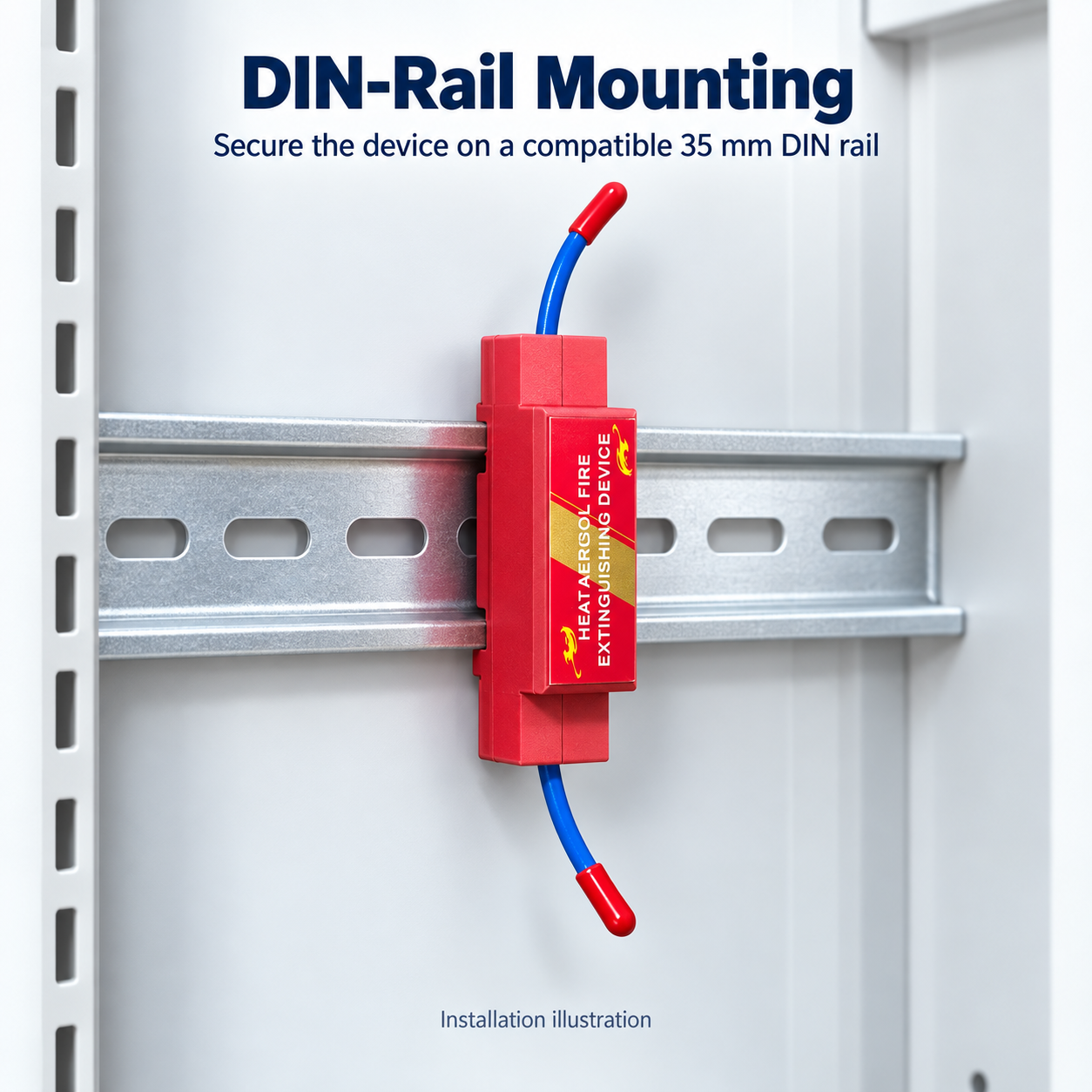
Position the device on a compatible 35 mm DIN rail, secure it and check that it remains firmly attached.
Adhesive mounting
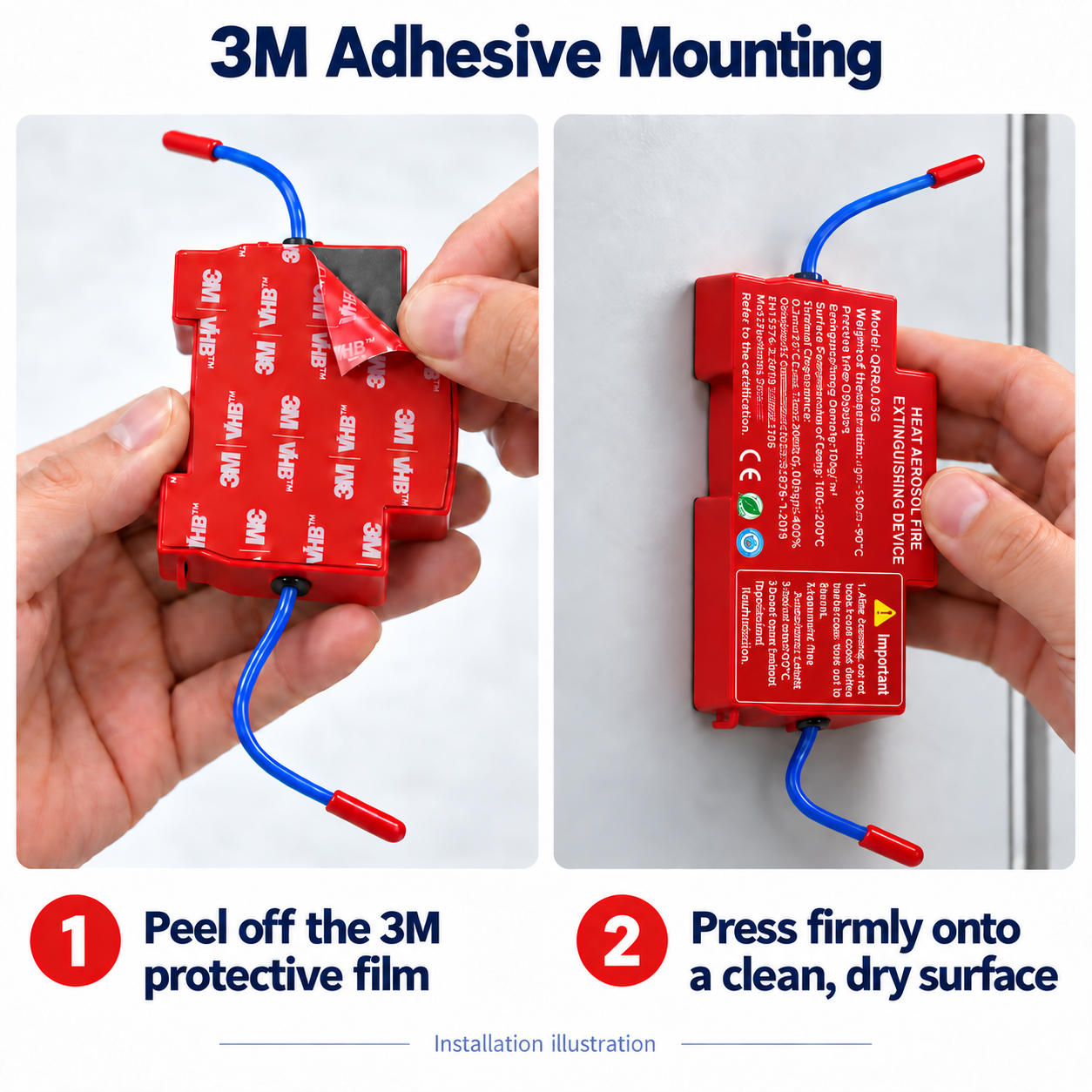
Clean and dry the flat mounting surface. Remove dust, oil and grease, peel off the protective liner and press firmly. Follow the specified bonding time for the selected adhesive; the exact adhesive grade and bonding time are not included in this package.
Thermal leads and inspection
Arrange the sensing cords clear of moving parts and exposed electrical terminals. Do not cut, modify or connect them to an electrical supply. Check that the device is secure and its discharge path is unobstructed. Inspect regularly and replace after activation or at the confirmed replacement date. The service-life discrepancy must be resolved before use.
Frequently asked questions
What is a DIN rail thermal aerosol fire extinguisher?
A DIN rail thermal aerosol fire extinguisher is a compact, single-use device designed to suppress fires inside electrical enclosures. It activates through heat or direct flame and releases a fire-suppressing aerosol without requiring an external power supply. The NEWLINK range includes 10g, 20g and 30g models with DIN rail and adhesive mounting options.
Is this device suitable for my electrical cabinet?
The device is intended for relatively enclosed spaces such as distribution boards, meter boxes, industrial control cabinets and machine electrical compartments. Suitability depends on the enclosure volume, ventilation, internal partitions, operating conditions and fire hazards. Share your cabinet dimensions and interior photos so we can review the application before recommending a model.
Which model should I choose: 10g, 20g or 30g?
Start with the cabinet’s internal volume and then check the installation conditions.
Calculate the internal volume as length × width × height, using metres. These values are selection references for suitable enclosure conditions. Ventilation, openings and separated compartments must also be considered; agent weight alone does not establish suitability.
Can I use several devices in a larger cabinet?
A larger cabinet requires an application review before selecting the quantity and positions of the devices. Internal partitions may prevent aerosol from reaching every compartment, and separately triggered devices may not activate simultaneously. Do not assume that adding the stated protection volumes automatically establishes coverage for a larger enclosure.
Does the device need electricity, batteries or a fire alarm panel?
No external electrical supply or battery is required for the thermal activation version. It operates independently of a fire alarm panel. The blue leads are thermal sensing cords, not electrical connection wires, and must not be connected to cabinet terminals. Applications requiring remote activation or alarm feedback need a separately specified solution.
What activates the device, and how does it suppress a fire?
The thermal sensing cords initiate activation when exposed to direct flame or the specified activation temperature of 170°C. Activation starts the internal aerosol-generating reaction. The released aerosol suppresses combustion by interfering with the chemical reactions that sustain the flame. Actual response depends on heat reaching the sensing cords.
Is aerosol generation duration a guaranteed extinguishing time?
No. Aerosol release duration is not a guaranteed time from ignition to complete extinguishment. The supplied TDS states ≤6 seconds, while the FAQ and working-principle text state ≤30 seconds. The applicable value remains under review; no final duration is presented here. Actual performance depends on the fire, enclosure conditions and installation.
How is the device installed?
The device supports attachment to a compatible 35 mm DIN rail or adhesive mounting on a suitable enclosure surface. Obtain the model-specific installation instructions and clearance requirements before installation.
What should I check before using the adhesive backing?
Check that the mounting surface is clean, dry, stable and compatible with the adhesive. Remove dust and grease, peel off the protective liner, and press the device firmly into place according to the adhesive instructions. Confirm that closing the cabinet door will not compress the device or its sensing cords. Consider temperature, vibration and door movement when choosing the mounting position.
Can the device be used in a ventilated cabinet or outdoors?
Ventilated cabinets and outdoor installations need a separate suitability assessment. Airflow and large openings can allow aerosol to escape, while moisture and weather exposure can affect the installation. Do not assume outdoor suitability from the operating temperature range alone. Provide details of the enclosure sealing, ventilation and environmental exposure for review.
What is the service life, and can the device be reused?
The device is single-use and must be replaced after activation. The supplied TDS and FAQ state 10 years, while the installation document states 3 years. The applicable replacement interval must be confirmed for the exact model and batch before use.
Does a stated service life mean no inspections are needed?
No. Service life does not remove the need to check the installation. Periodic checks should confirm that the device remains securely mounted, the sensing cords are intact, and the discharge area is unobstructed. Cabinet modifications, additional equipment or changes to ventilation may require the protection arrangement to be reviewed.
Is the aerosol residue-free and suitable for sensitive electronics?
Aerosol contains fine particles, so it should not be described as completely residue-free. Applications involving sensitive electronics require a review of the relevant test data, equipment compatibility and post-discharge cleaning requirements. After activation, have the affected equipment assessed before returning it to service.
What technical documents can I request before ordering?
Ask for the current technical datasheet, installation instructions, applicable test reports and certificates, and SDS/MSDS and transport documentation where relevant. Confirm that the documents cover the exact model and agent formulation being purchased. Requirements for a particular market or project should be reviewed before the order is confirmed.
Can NEWLINK provide OEM branding and samples?
NEWLINK supports OEM enquiries for product labels and packaging. Please provide your required models, quantities, artwork and destination market so we can confirm the available options, minimum order quantity, sample arrangements and lead time. Custom labels should retain the required product identification and safety information.
What information should I send for a quotation or model recommendation?
Please provide the cabinet’s internal dimensions, interior photos, ventilation details, operating environment, preferred mounting method and required quantity. Include the destination country and any project-specific documentation requirements. These details help NEWLINK review model suitability and prepare a quotation.
Need help selecting a model?
Send your cabinet dimensions and photos to [email protected] for an application review and quotation.
Technical downloads
Supplier source TDS — review copy
Applies to the listed QRR0.01G/S, QRR0.02G/S and QRR0.03G/S models. Source format: DOCX. Supplier revision date: not stated. Imported for local review on 8 October 2026.
This source file contains the unresolved release-duration and service-life values. It is not an approved final datasheet. A versioned PDF, installation manual, applicable reports and certificates remain outstanding.
About FireAerosol & OEM enquiries
The supplied company profile describes FireAerosol as a brand focused on compact fire-suppression devices for electrical enclosures. OEM enquiries can cover product labels and packaging. Share your model, quantity, artwork and destination market to discuss available options, samples and lead time.
Request a quote & application review
Include cabinet dimensions with units, ventilation, operating environment, preferred mounting method, quantity and destination country. Model suitability and documentation requirements will be reviewed with your inquiry.